




I recently started as a Product Designer at OpenEnvoy. Here at OpenEnvoy we enable finance teams of all sizes with visibility, automation, and cash flow solutions. Think enterprise B2B/SaaS in the finservices space. I was employee number 32 and we currently have 48 employees at the time of writing.
When I joined OpenEnvoy, there was a ton of headroom for growth. Add to the mix the age-old time scarcity of startups, setting myself up to produce high impact work as quickly as possible became a key to success. Working at OpenEnvoy is my 2nd rodeo being a designer on a small design team, so I wanted to share a few specific strategies I have learned along the way to help you maximize your impact as a Product Designer (or in any design role) and get you moving quickly in your first 90 days.
Prioritize Impact and Speed
For starters, consider strategies like being a learning sponge, establishing key relationships, and deeply understanding the company’s business model as table stakes for successful onboarding.
#1 Start Shipping ASAP
You will get up to speed considerably faster by doing compared to studying. Work with your manager or stakeholders to align on a project that won’t overwhelm you, but still allow you to prioritize shipping products. Hint: it’s usually found in places that aren’t fun but still impactful.
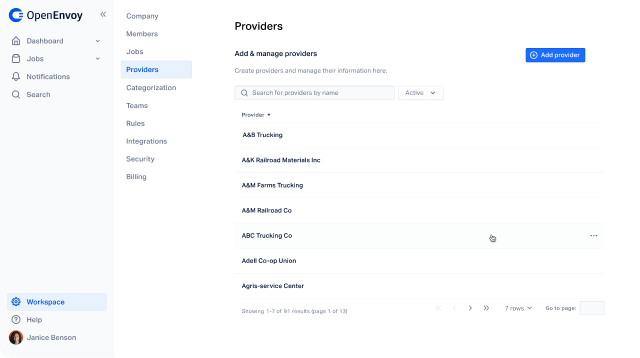
When I first started, I had to learn all the complexities of accounts payable (AP) and invoice auditing. In order to still contribute with my design skills while learning, my first project was designing a vendor directory that didn’t require a deep understanding of the AP process. This also could have been other non-specific product areas like settings pages, share/invite features, etc. As a result, I was able to hand off designs within my first two weeks.
How this was impactful
- Finding non-specific product areas that required design input shortened the timeline for me to make tangible contributions to our live product, without getting overwhelmed by a steep learning curve.
- Shipping product quickly also doubled as a great way to build relationships with engineers beyond introductory meetings and allowed for real-time actionable feedback on our product development process.
#2 You Can Mine for Gold or You Can Sell Pickaxes
Andreessen Horowitz’s Chris Dixon has written about the idea of mining for gold versus selling pickaxes when building companies:
"When a major new technology trend emerges – say, the rise of online video or social media – entrepreneurs can try to capitalize on the trend by creating a consumer product (mining for gold), or by creating tools to enable consumer products (selling pickaxes)."
The same idea applies when doing design, or any function, at a company. You can ship product (mine for gold) or build tools to enable shipping product (selling pickaxes).
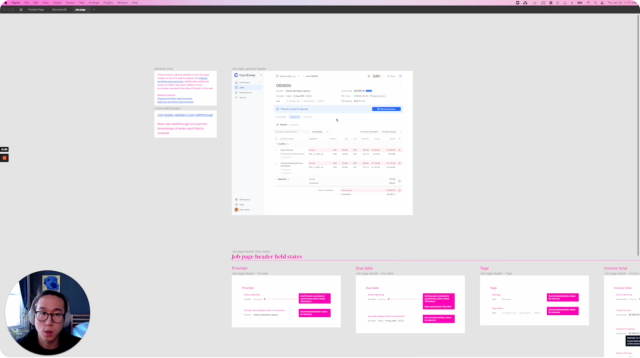
With my domain knowledge still ramping up, I wasn’t ready to design features for our core offering, so instead I focused on selling pickaxes by up-leveling our developer handoff process and documentation standards. My contributions included transitioning our design process to Figma, creating project templates, and establishing a repeatable handoff process.
How this was impactful
- Leveraging skills I already had—scaling and optimizing design processes—gave me an opportunity to contribute immediately to our design team while I built domain knowledge.
- Standardizing the design and handoff process is a necessary investment as the design team grows. By following a streamlined process, design moves faster, handoff is more seamless, and new designers can onboard more quickly.
While this may not be the most glamorous work, building the foundation on top of which our design and product teams can scale is invaluable for future success.
#3 Lead With Trust
Author and speaker John Hall, describes trust as two things:
"First, that every team member is making their best effort to further the interests of the company; second, that everyone assumes that fact about everyone else on the team unless they see evidence to the contrary."
When you look at it, it’s clear that trust goes both ways: you trust others and others trust you. While for some, this may take a bit of unlearning, I encourage you to discover what defaulting to trust has to offer.
At an early stage startup, you’re hedging on a hypothesis that’s in the early stages of validation and there can be uncertainty. Combine that with wanting to make a good impression as a newcomer, and it’s easy to get stuck in analysis paralysis of decision-making. For me, trust was a place to stand at every turn: trusting my contributions were valid, trusting the contribution of others, and trusting we had each other’s back. I had the freedom to make mistakes, share my learnings with the team, and most importantly move our product forward.
How this was impactful
- Defaulting to trust, especially in the early days of the company, acts as a cornerstone of the company’s identity and culture. In the long term, this impacts everything from interpersonal relationships to hiring.
- Throughout all the growing and the pivoting of an early stage company, leaning into trust gave me peace of mind and allowed me to focus on my contributions. Onboarding could have felt sink-or-swim, but instead I was excited about joining a great team who was set to accomplish big things.
A Healthy Challenge and a Huge Upside for Learning and Impact
Imagine you’re playing the child’s game Hot and Cold. You’re the person (the startup) seeking and the other players (the market and your customers) are telling you if you’re getting hotter or colder. At the beginning, you’re far from the prize so people just say “hotter” “colder”, but you keep looking. Soon, you get closer, and you feel the excitement start to build. You’re looking frantically! People are shouting “Hotter!” “Colder!” Now, you’re really close! You’re excited! Everyone’s excited! People are screaming HOTTER! HOTTER! And then you find your product/market fit and hope you’re strong enough to carry your prize home.
There’s an amazing opportunity that comes with designing a product at an early stage startup. Not only do you get to see what those first steps look like, but you get to be part of the core group that decides where they go. Besides, without those first steps, you’ll never get to the point where people are screaming “hotter” in your face. Fast forward to now and I’m continuing to build off the momentum from my first 90 days. People aren’t screaming “hotter” yet, but they are yelling louder every day!



-1.png)

Serious about protecting your cashflow?